Written by Brittany Haas
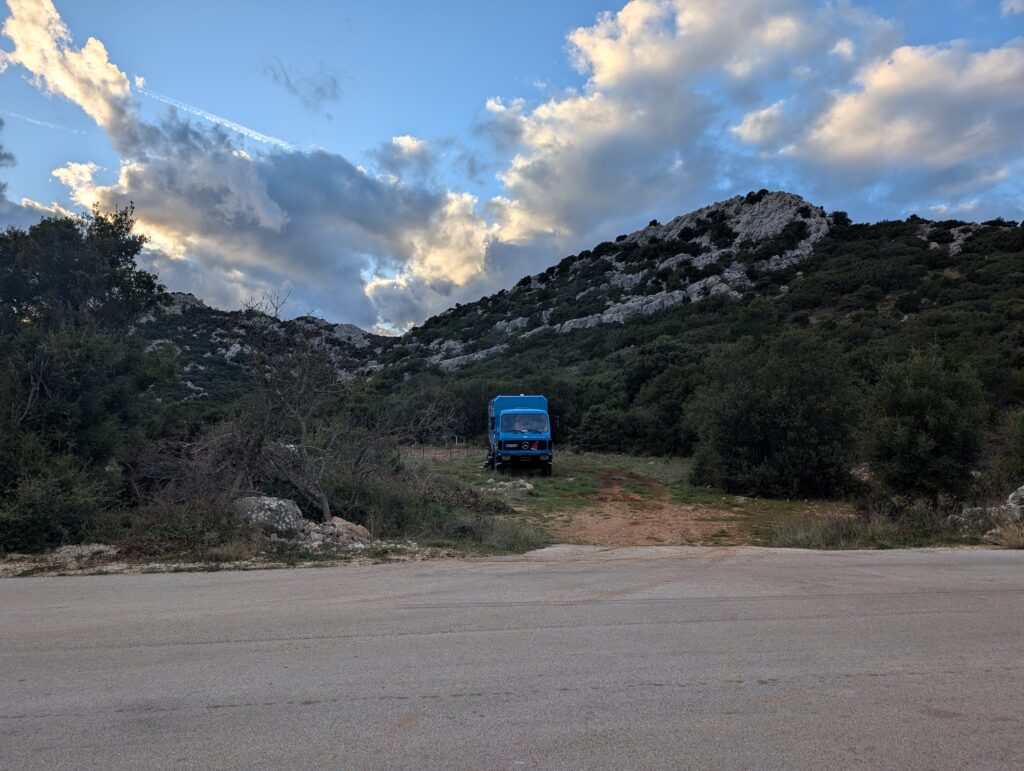
New Year’s was a simple affair for us this year, parked near the tip of the Peljesac Peninsula, still in Croatia. We found a perfect little pullout at the base of a rock climbing area and across the street from one of the approaches to the Sveti Ilija, a stony mountain that rises 961 meters directly out of the sea. When the clock struck midnight on New Year’s, we were a short walk away from our cozy parking spot, at a small overlook, where we could see several sets of fireworks, all small displays to match the size of the surrounding villages.
On New Year’s day, we bundled up, although not enough, and headed up the nearby mountain. We covered the first stretch by mountain bike, making our way slowly up a winding gravel road until we arrived at what used to be a parking lot before the gravel road was closed to traffic. We parked our bikes and headed out by foot, maintaining a fast enough speed, that we broke a sweat ascending the first steep and rocky section. It’s winter, so breaking a sweat and making your clothes wet unnecessarily was bad technique and something experienced mountaineers shouldn’t do. Oops.
The hike up the mountain was pleasant and took us through varied terrain, including forests that sometimes looked like we were deep in the jungle. We passed two small huts, both closed. There were more people on the trail than we expected, and we were thoroughly surprised at the second hut to run into a group from Bosnia and Herzegovina who had a full spread of local sausage, cheese and sweets that they offered to share with us. This would be our first introduction to the friendliness of Bosnia and Herzegovina.
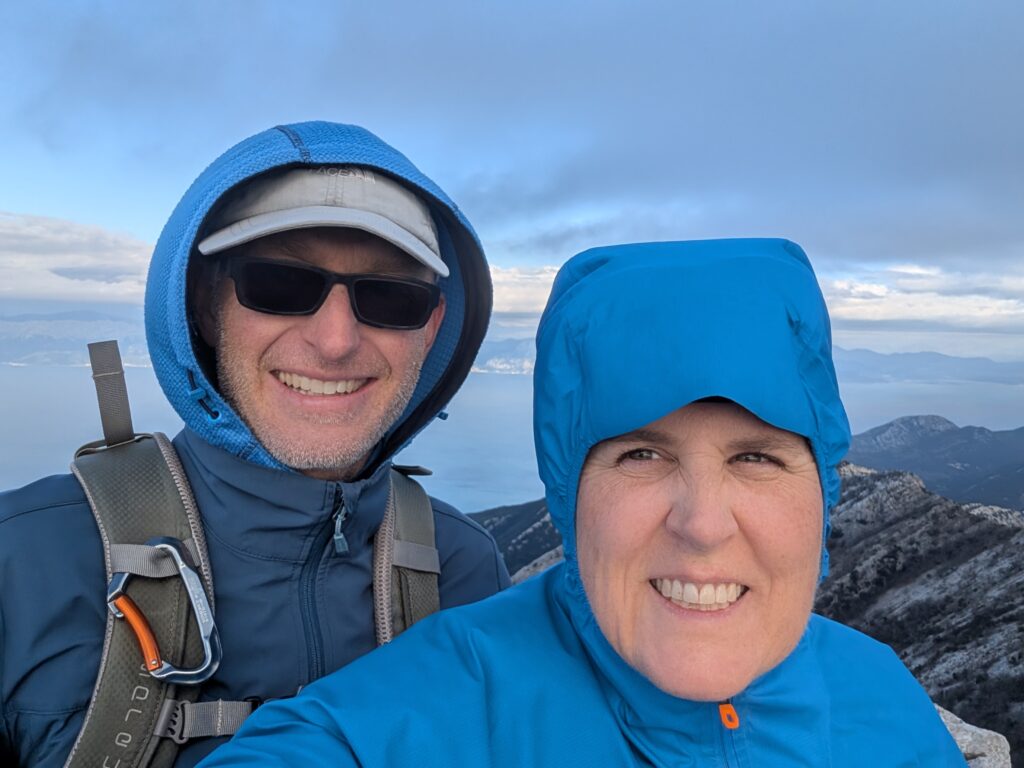
Despite clear skies and beautiful views, we were chased off the summit by a strong and icy wind. Still mesmerized by the terrain, our descent traced the same line as our ascent. When we were almost to the first hut we had passed on the way up, we suddenly heard the sound of animals running toward us. The terrain surrounding us had clearly been battered by masses of hungry wild pigs, for which there were warning signs all over the country. Wild pigs are known for their aggressive grumpiness, and they are not a pleasant surprise encounter.
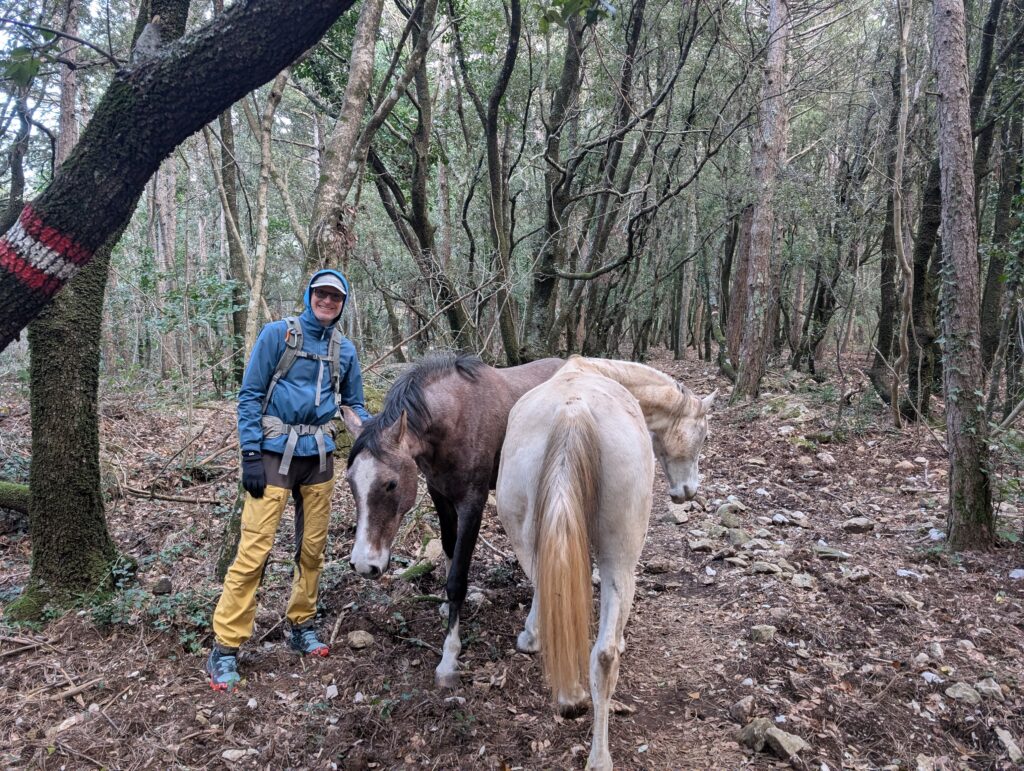
But it turned out that what was running toward us was much larger. The first words out of Chris’ mouth were, “Wild horses.” They ran at full speed for us, following the single path through the forest, the same one we were on. We stepped aside to make way for the stampede of horses to continue at their clip past us, but the first one stopped abruptly directly in front of Chris and aggressively demanded pets. A few horses continued running, but some even circled back to us once they noticed we were offering ear scratches. So, it turns out, they were not wild horses at all. They were instead, very lonely and aggressively friendly horses that just needed some love.
That evening, we decided to drive on to a lonely beach at the tip of the peninsula that we found on the satellite map. Shortly after we made the turn onto a tiny dirt road, we encountered traffic coming toward us. The driver absolutely wanted to speak with us, and he explained that the road was not suitable for our truck. Through the language gap, our understanding was that there was one very tight switchback and we needed to be very careful. He was clearly gravely concerned about our intentions. We thanked him for the information, and cautiously continued on the road. It quickly became clear that his warning probably had something to do with steep drop-off that came into view.
We could see switchbacks on the map. By now, we had done many switch-backed roads in Croatia, all without issue. There was even a sign at the turnoff to this road that a fish restaurant lies ahead at the beach in 3 kilometers, with no warnings about the character of the road. As the road began to tip down toward the sea, we pulled off to the side, turned off the motor, and headed down the switchbacks on foot to check things out. Dark clouds were rolling in around us about as fast as darkness was setting in, and time was limited. The culprit was a few switchbacks down, a tight hairpin bend with a steep grade and a drop-off that would require a multiple point turn with zero margin for error. We walked back up the hill to Tusker, arriving just before dark, backed off and headed for a parking lot in the center of the nearest village, hoping we would be lucky enough to find a restaurant that was open.
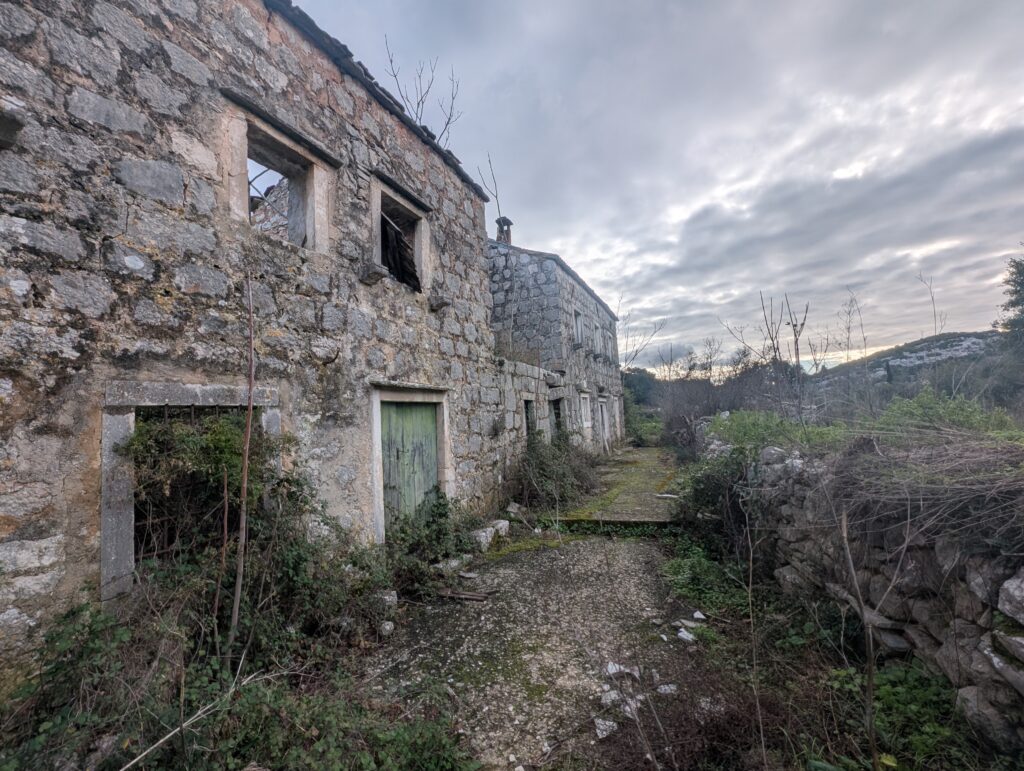
The next morning had a nice enough forecast that we were optimistic we could fit in some rock climbing with minimal misery factor. So, we headed back up to our previous spot, grabbed our rock climbing gear and headed out. We didn’t have very good information about how to get to the crag, but we figured it out. This crag had two sections…one was very difficult and the other had several easier climbs that we were looking forward to. The area is an important historic site, that was inhabited for 8,000 years, up until very recently. There were abandoned villages, ruins, churches and an ancient zodiac dating back to 1,000 B.C.
Read more about the history and ruins in the Nakovana region
Our drive back to the mainland was nothing short of spectacular, as we crossed multiple passes, criss-crossing the peninsula’s rugged terrain. Our next stop was Ston, famous for its 5 kilometers of stone walls that were built in the 14th and 15th centuries to restrict access to the peninsula. The area is also famous for its oysters, so Chris ordered a kilogram of oysters for dinner that night. The next day, we donned our raingear and bundled up, being the only tourists to brave the walk along the walls to the neighboring village, Mali Ston.
As Sunday was coming to a close, it was time to start thinking about the workweek. We had researched a spot on the outskirts of Dubrovnik, where we expected to settle in for a week of work. Luckily, January 6th is a holiday in Dubrovnik, so we would have one vacation day to visit the city. We found ourselves at a small harbor packed full of small fishing boats, certainly belonging to locals. Across the sea, the Dr. Franjo Tudman Bridge towered above us, keeping us entertained in the evening with its brilliant lighting, sometimes even with varying colors.
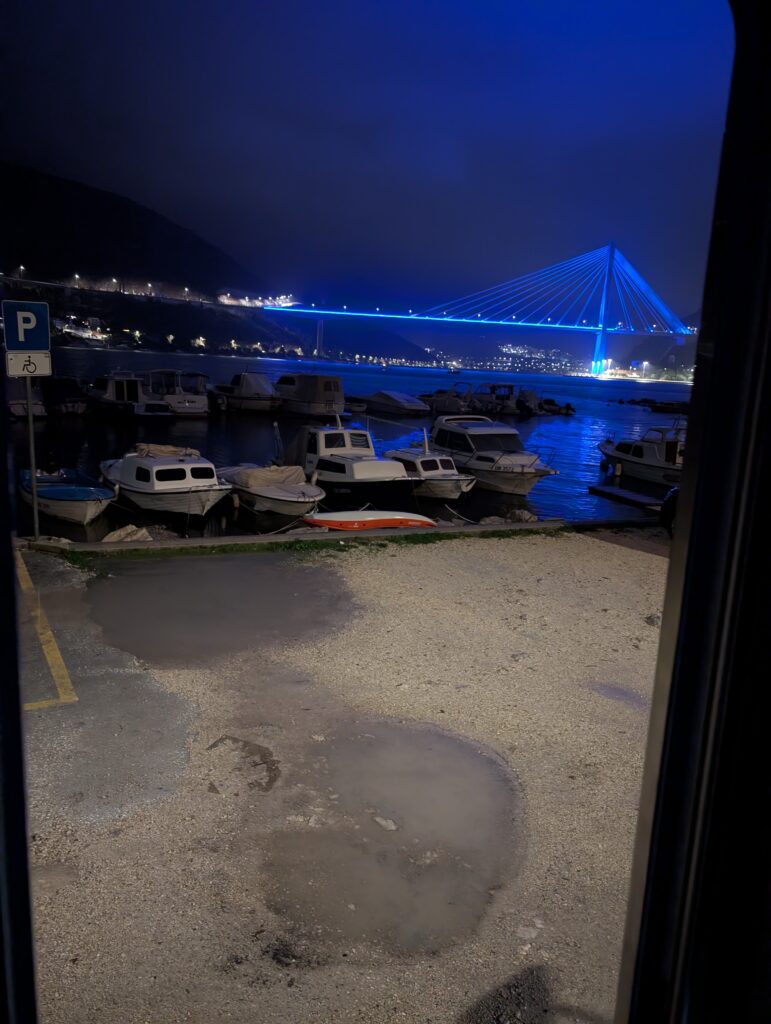
We endured a week of heavy rain and wind in Dubrovnik, although our little spot on the harbor was wind-protected. The weather was so unpleasant that not a single fisherman pulled his boat out of the harbor. Instead, the boat owners were regularly pulling up beside us to check how their boats were holding out in the storm, and often to bail water out. Chris even helped bail out a small rowboat that was slowly sinking.
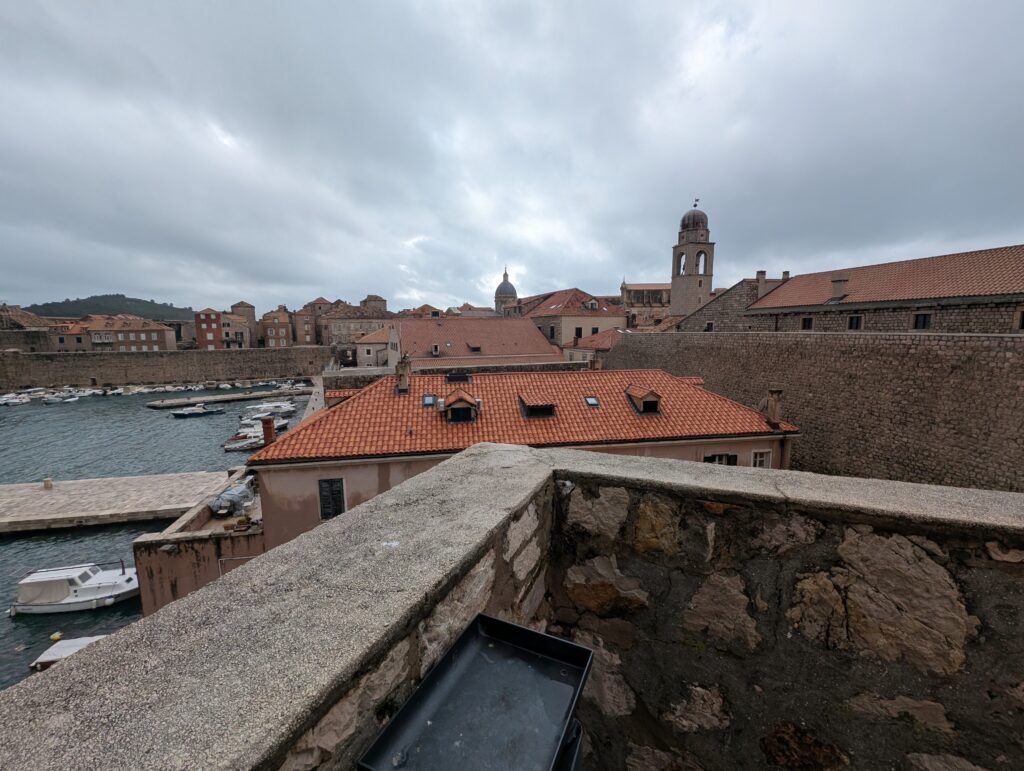
As planned, we visited the city, wet and windy, on our January 6th holiday, spending more time in museums and cafes than usual. Dubrovnik, with a rich history as a major sea port, medieval architecture, and still-intact city walls, is a UNESCO World Heritage site and is bombarded by tourists in summer. We were thankful to experience this treasure without the crowds, even if it meant there was some misery factor from the weather involved.
It was only about a 20-minute drive out of Dubrovnik to our first border crossing into Bosnia and Herzegovina. Here, we exited the EU for the first time on our trip and experienced a true border crossing. We were excited to see what awaits in our next country, country number six on our route so far.