It was about 10:30 am, and we stood high on the side of a mountain, above the nearly abandoned village of Umoljani, staring at a nasty traverse ahead of us. When I say “side of a mountain,” I mean that our snowshoes were resting on top of the snow at an angle severe enough to cause my new-ish, and usually very comfortable winter boots, to dig into my skin. But that was the least of my worries, as I realized the sketchy traverse across a steep mountain slope ahead was a definite no-fall zone. The way back was only slightly better, but going down this steep slope was just as intimidating. There I stood, with just two hiking poles in my hands, reminding myself what my Colorado friend, Dave, learned the hard way and repeatedly said, “always bring an ice axe with you on a winter mountain tour.” A concept I am very well aware of, but sometimes forget. Like I did today. Or at least I thought so.
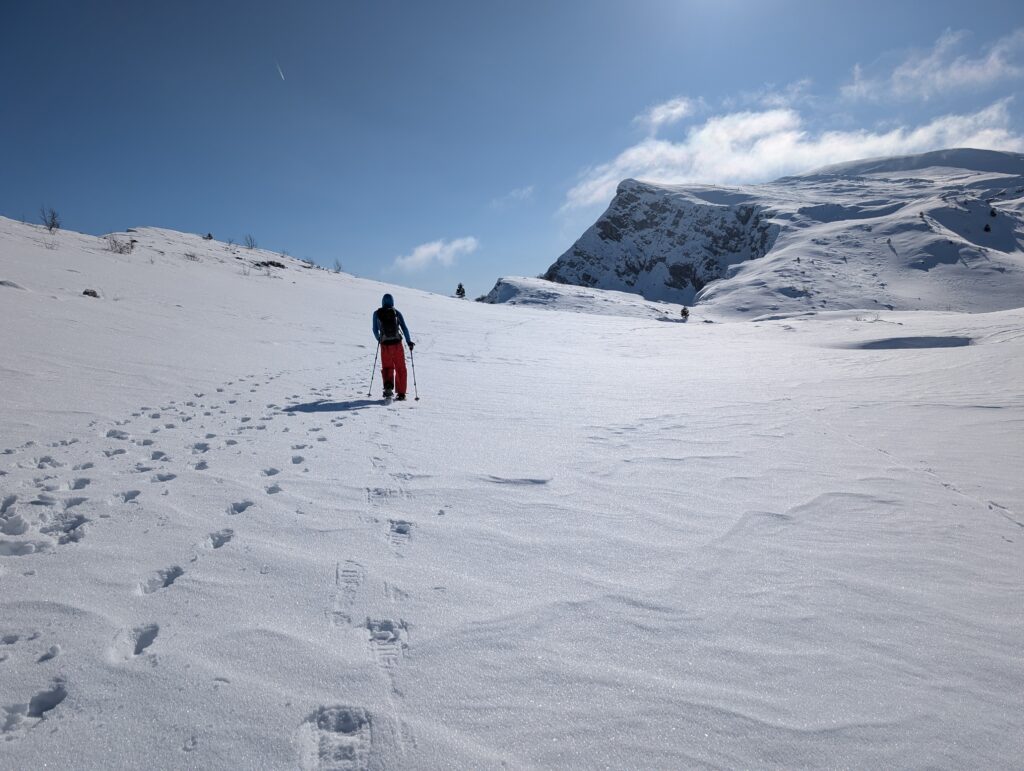
While my thoughts were driving me into a deep hole of self-criticism, Chris remained practical and interrupted my thoughts by asking whether he should get the emergency ice axe out for me. “Oh, yes please.” This is among my favorite benefits of marriage…approaching all problems with two brains. He handed me the emergency ice axe, which was shorter and lighter than my regular ice axe, but for a side step on a slope as steep as this, it was more than long enough. I stuffed one pole on the side of my pack, attached the leash of the ice axe to my uphill hand, and plunged it into the snow. With a third anchor point, I moved forward with ease and crossed that slope without a worry in the world. What a difference the right equipment makes! And Chris, well, he didn’t use an ice axe and didn’t feel like he needed one either.
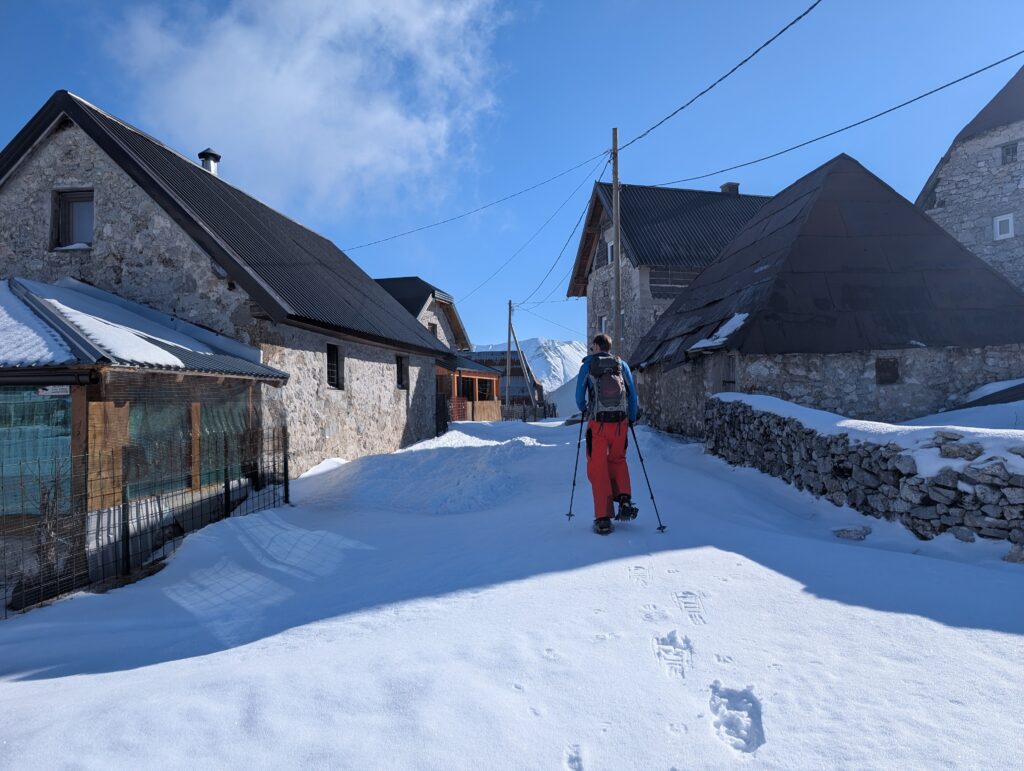
We were a few hours into a massive snowshoe tour, on our way from the sleepy streets of Umoljani to the hibernating streets of Lukomir, the most remote mountain village in Bosnia and Herzegovina. Cut off from civilization in the winter, Lukomir sits right on the edge of a cliff, towering over the Rakitnica Canyon, one of the deepest canyons in Europe. I read that a handful of residents remained over the winter, but when we arrived, it was clear the village was empty. The last snow had fallen about two weeks earlier, and since then the deserted streets winding between the traditional stone houses had seen neither human nor animal.
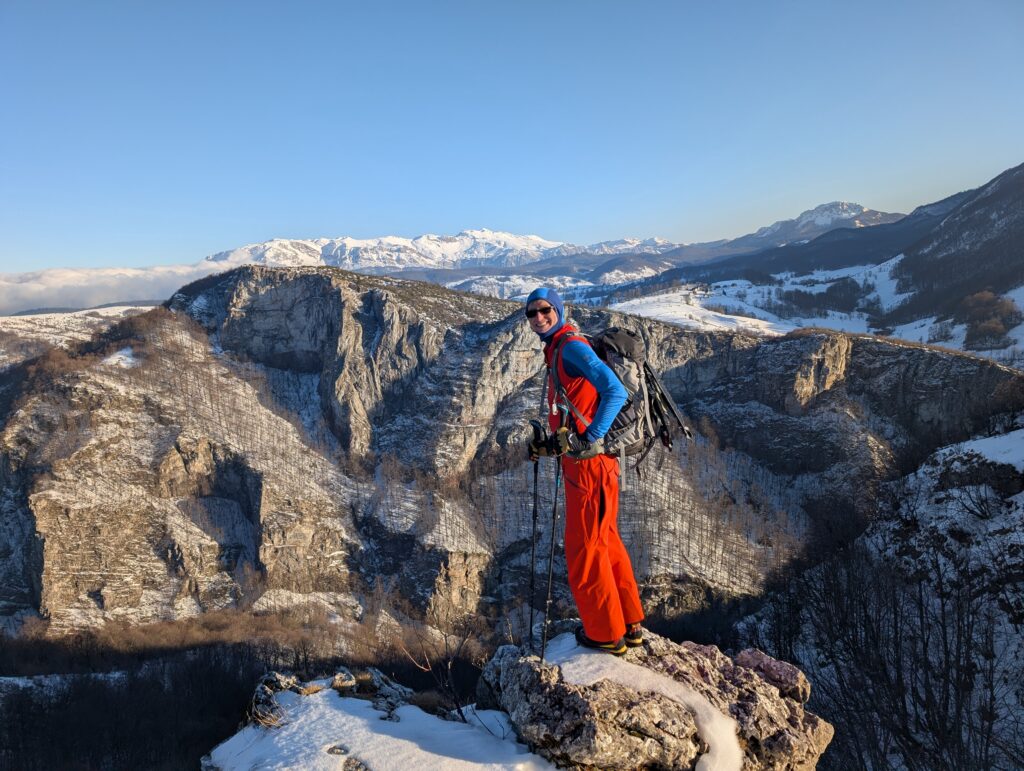
Short winter days and an ambitious tour with unknown conditions meant we didn’t have much time to explore Lukomir, which was a shame. The route we took over the mountains to get here was not an appealing option for the return, especially not so late in the day. The most direct return to Umoljani is via a trail that cuts across the canyon wall, but we were not certain it would be passable. All it takes is one nasty, snow-filled gully or icy step with exposure to block our path. The most certain route, mostly following snow-covered dirt roads around the mountains, was long and would lead us well into the dark before we returned to Tusker.
We opted for the most direct route, which was mostly south-facing, and much of the slope was bare of snow. Although we were so high up that the river at the bottom of famous Rakitnica Canyon was not visible, this was also our best chance to get acquainted with one of Europe’s deepest canyons. If you know us, you know that canyons play a major role in both our lives, whether it’s the Grand Canyon or a small stream that plummets down a mountainside, offering multiple rappel opportunities.
As is our habit, we arrived back at Tusker just before we would have had to pull out our headlamps. After 16 kilometers on snowshoes, we were exhausted and quickly agreed that we would not drive anywhere, a perk that comes when your house is always parked at the trailhead. On our way in the day before, the last 3 kilometers of the road up to Umoljani were steep, winding, and one-lane wide. A switchback on the way up delivered a 3-point turn. We were simply too tired to drive this back down.
The conditions were perfect on our Umoljani snowshoe tour, with perfect blue skies, light wind and snowpack hard enough that the snowshoes barely sank in. We were surprised by the great conditions, because the forecast for that day was mostly cloudy, with only a little bit of sunshine poking through. After spending nearly a week in heavy fog, we were thankful to break through the top of the cloud layer just 15 minutes into our day and to remain above the clouds for the rest.
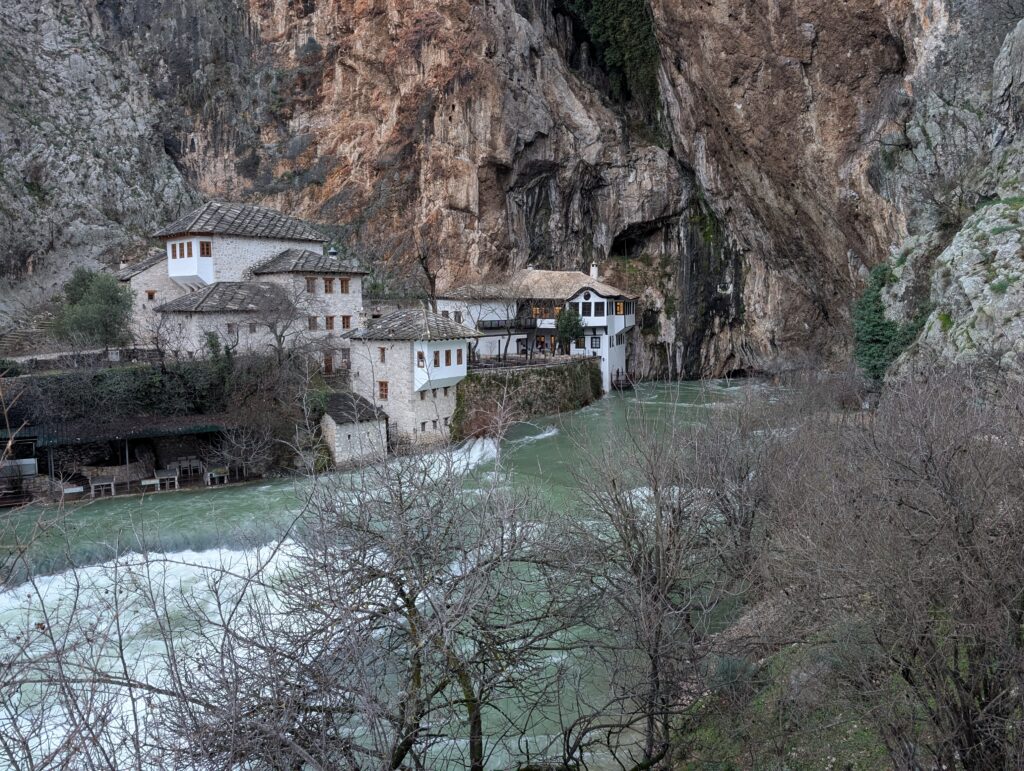
We entered Bosnia and Herzegovina from Croatia at the Ivanica Border Crossing in early January. The weather was gray, but after waiting out the prior week of heavy rain in Dubrovnik, it was more than acceptable. Our first stop was the village of Blagaj, southeast of Mostar, the site of a famous Dervish monastery tucked beneath a cliff, exactly at the point where a spring, aka a raging river, shoots out of the base of the cliff. We’re not always drawn to cultural sites, but the photos pulled me in.
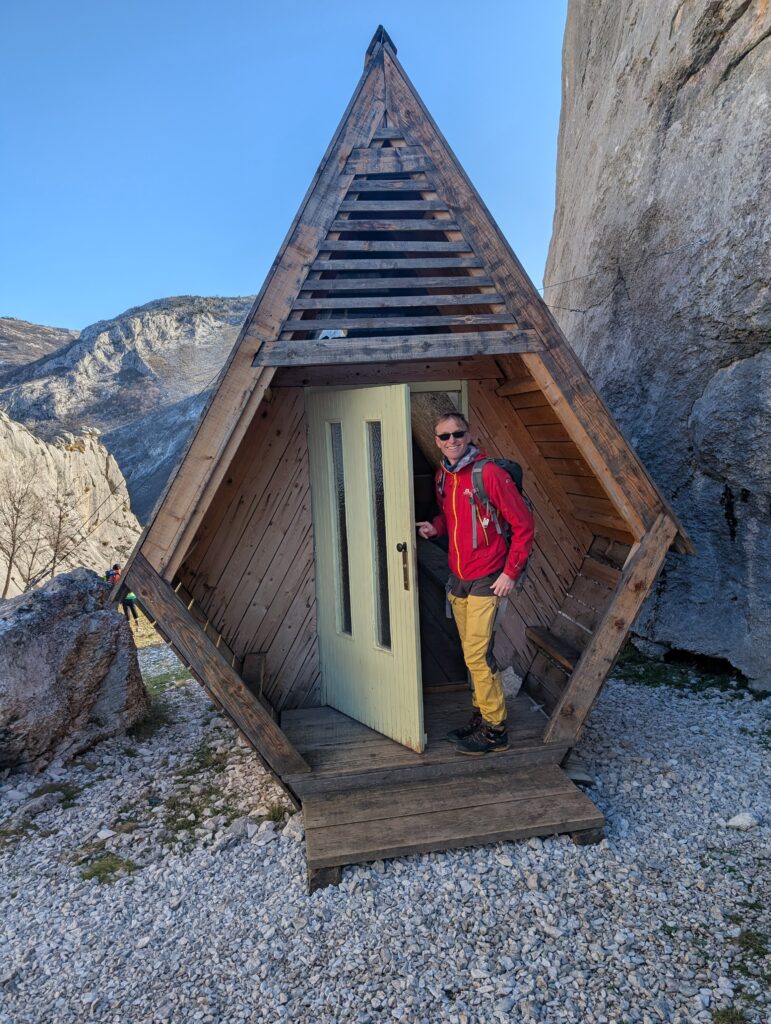
While researching Blagaj the night before, I noticed a via ferrata in the town, and used my favorite topo map app (Outdooractive) to plot out a nice loop that would start from near the monastery, ascend a via ferrata, continue along a hiking trail with an off-trail side-trip to a summit, go to a castle and then descend back into town. We were surprised to find the via ferrata in a canyon rather than on a rock face, and enjoyed the humor of engaging in an activity that takes us up a canyon rather than our preferred direction, down the canyon. As we emerged from the top of the via ferrata, our trail continued uphill, making its way across a stony landscape toward the next peak. We noticed a sign for a rock-climbing area, probably the 5th we had seen since we arrived, and wandered over to check it out. I must say that I have never been so delighted by a climbing crag in my life. We followed a long and narrow patch of green grass, worthy of a suburban front yard, between two rock walls to the most adorable little sleeping shelter I have ever seen. As we admired the quality of the rock and I counted how many of the routes I was not capable of climbing, we reached the end of the lawn and took in the view out toward layers of stony mountains and the sea. Here, I became convinced that Blagaj is absolutely a destination for rock climbers.
That night, we drove into Autocamp Victoria in Mostar, needing a power and water fill-up. We were greeted by the owner, who engaged us in conversation via Google Translate over welcome drinks. We were the only guests, which is quite typical this time of year. There really don’t seem to be any other campers driving around the Balkans right now. We completely understand why…it’s definitely not a good season for it.
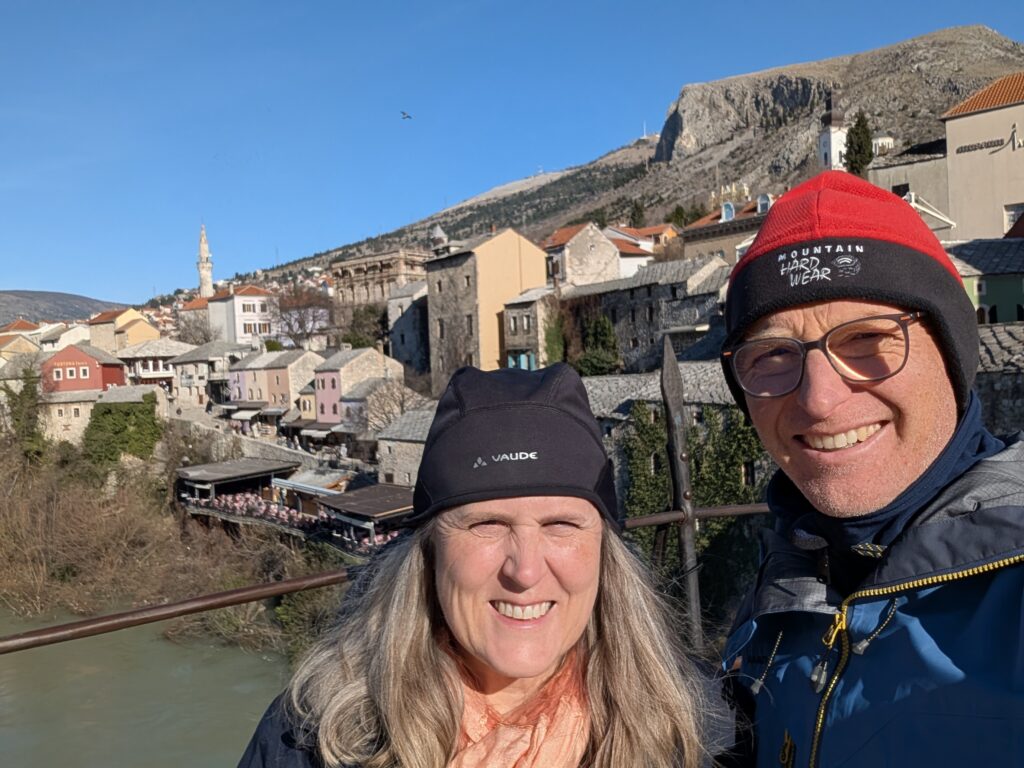
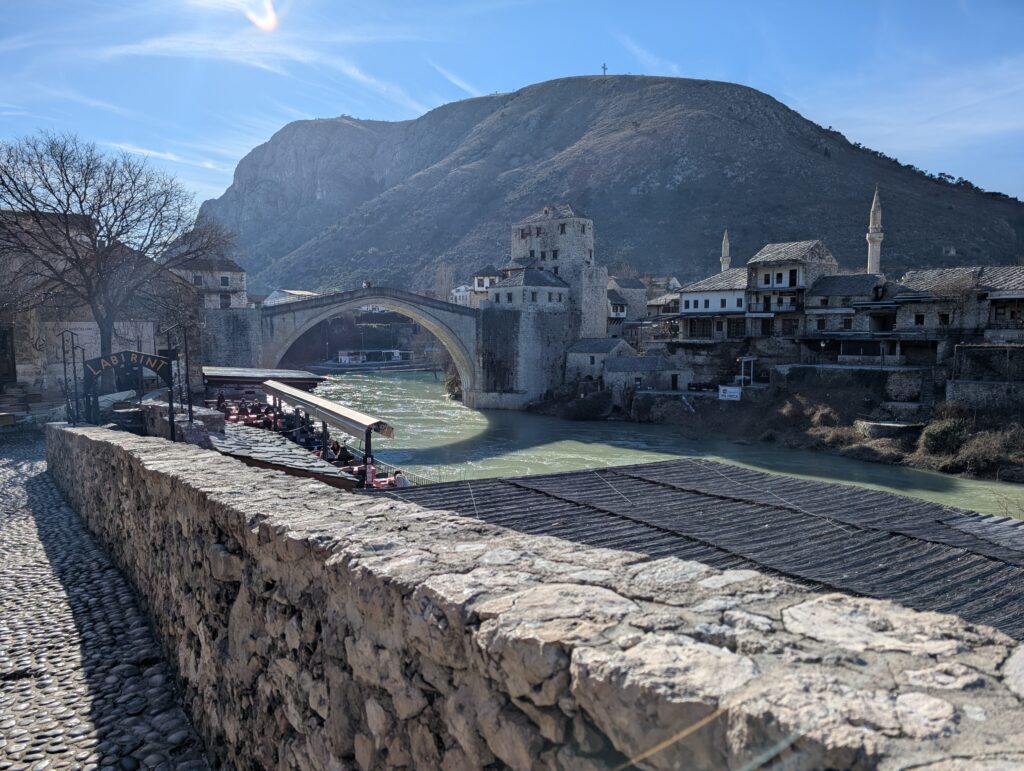
Our day in Mostar was sunny and relaxed. Well, we walked 18 kilometers, but it was city walking and didn’t feel strenuous. The old town section of Mostar, featuring a famous bridge over the Neretva River, was small but interesting. But this simple visit to Mostar, may have changed a little something in me forever.
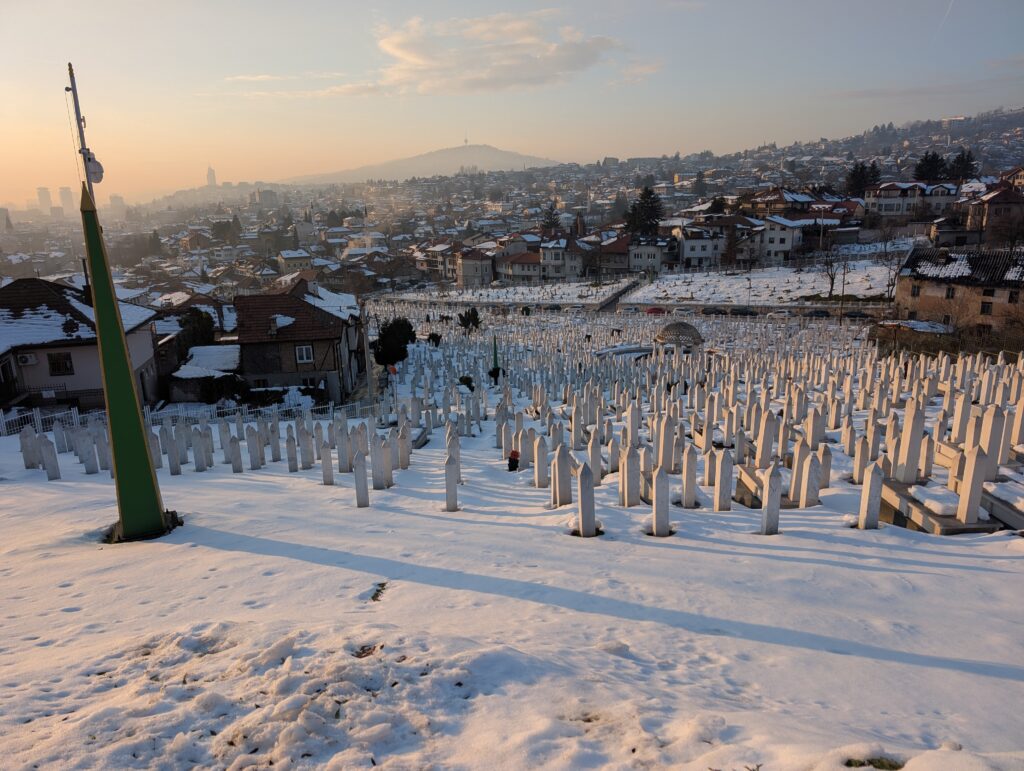
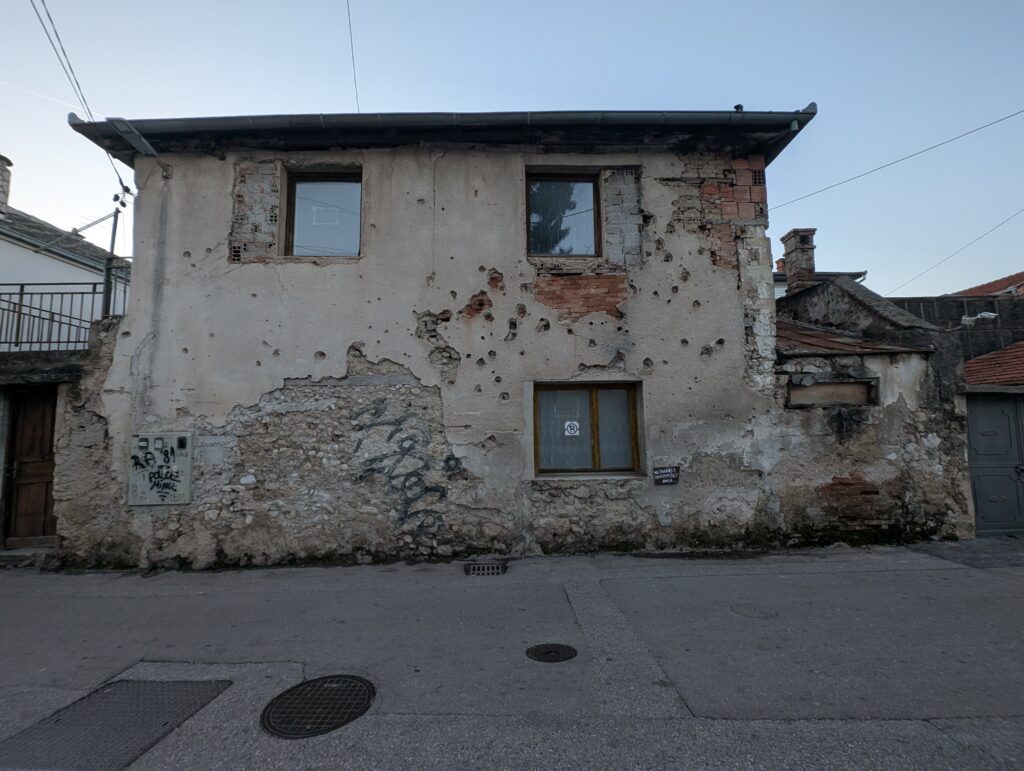
It’s time to get real and talk about some very ugly stuff…genocide. It’s mind-blowing that such a beautiful country full of friendly and good-hearted people could have such a dark past. On our visit to Mostar, we wandered over to a mosque and then continued on into the adjacent cemetery. Across the street from us stood the ruins of a building, the scars of gunfire still visible on the crumbling façade. After a few minutes of walking through this expansive cemetery, we realized that everybody there died between 1992 and 1995, and while we aren’t experts in these names, it seemed that they were all male. Muslim and male. This is when it hit us. We were standing among the victims of the brutal war, which hosted one of the worst genocides in history. Almost at this very moment, the call to prayer sounded from the speakers of the mosque, a sound that almost haunted me as I reflected back on the movies and documentaries we had recently watched about the war and the genocide. I sobbed.
Since that moment, my mind has been spinning. My skepticism toward power and ego has deepened, while my conviction that peace must come first has settled firmly at the forefront of my thoughts. I couldn’t resist writing some of these reflections down. You’ll find them at the end of this post if you are interested.
After Mostar, our next destination was Blidinje National Park, home to a famous high-altitude lake, mountains and a ski resort. Immediately north of Mostar, we entered snow as we slipped into a deep gorge. We were delighted by the changing ridgelines and sculpted mountains that surprised us with every twist and turn. The next day, we struggled to find our way out of this gorge, because the road we wanted to take up to the National Park had a winter closure for vehicles over 3.5 tons. After a short trip to the police station to inquire about our route, we headed out on a very long detour to reach our destination.
This detour would not pay off, because our visit to Blidinje National Park was quite miserable. Fog surrounded us, we couldn’t see a thing, there was enough snow to be a nuisance but not enough to enjoy it, and the frigid wind was howling. We cut our stay there to just one night, and reduced our 2 planned snowshoe tours to an hour-long walk on an ice-covered dirt road along the lake.
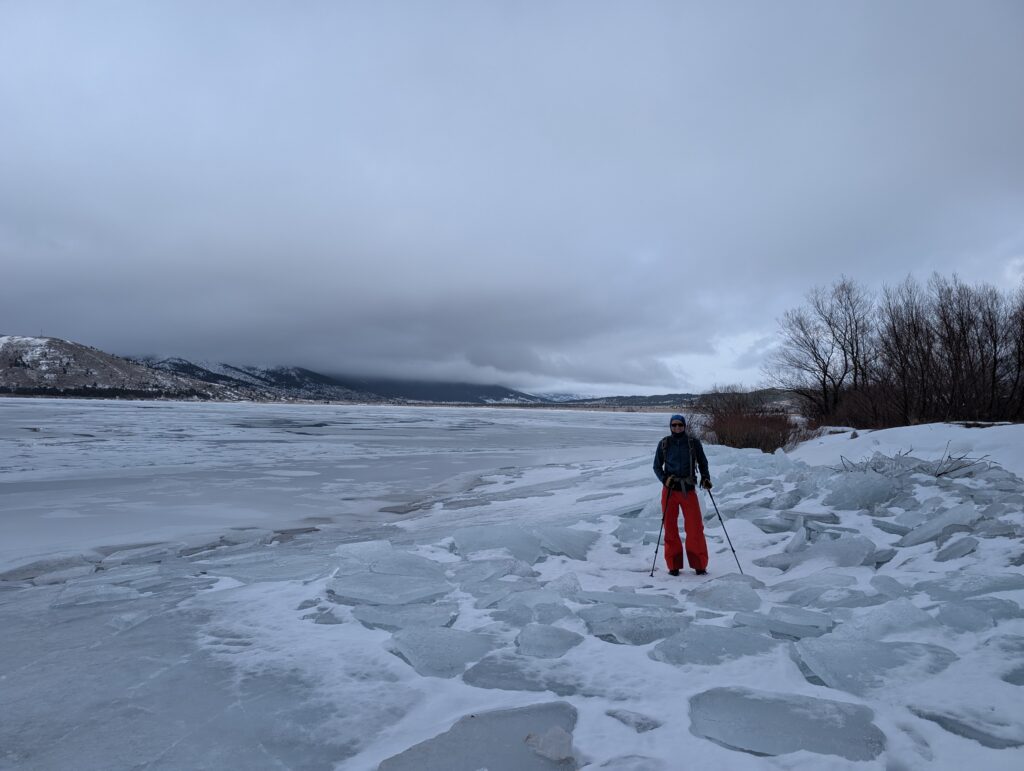
The fog would follow us for the next few days, no matter how hard we tried to escape it. The sun was even forecasted to come out for our Sarajevo visit, but cut deep into a valley where the cold winter air was stuck in an inversion, we simply transitioned from fog to smog. We were happy to see Sarajevo, doing a typical ½ day city visit. I am sure its mountain setting is stunning when there is not an inversion, but we were ready to get out of there and find some clean air.
Our next destination was high in the mountains, where we were hoping to escape both the smog and the fog. Within 30 minutes of driving, on our way to the Bjelašnica Ski Resort, we emerged from it all to brilliant blue skies and glorious sunshine. We loved this mountain region. In addition to our unforgettable snowshoe tour from Umoljani to Lukomir and back, Chris fit in a downhill ski day and I was even able to do a couple of rounds with my cross-country skis. To top it all off, we engaged in several conversations with friendly locals, including an invitation to famous Bosnian coffee, and also treated ourselves to a relaxing evening in the wellness area at a spa hotel.
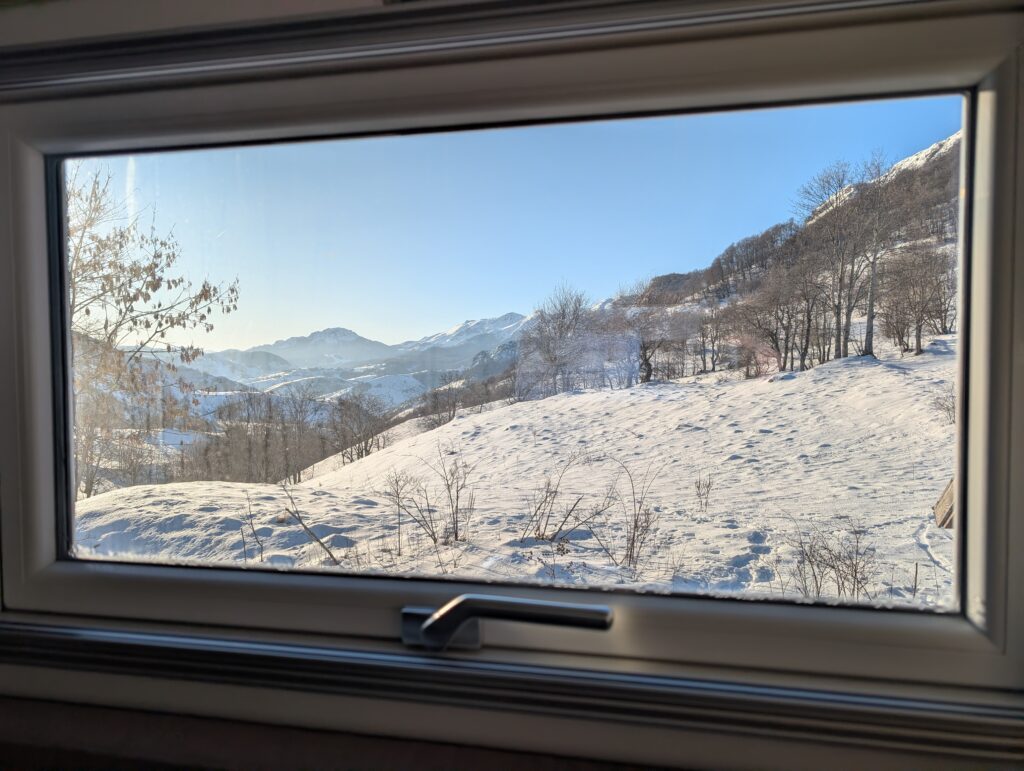
But all good things must come to an end, and we knew it was time to continue toward Montenegro. We were thoroughly impressed by Bosnia and Herzegovina, but we simply hit it at the wrong time of year. Our willingness to continue on to Montenegro was contingent on a commitment to return to Bosnia and Herzegovina in a better season…someday. But Bosnia and Herzegovina was not yet done with us, and it gave us a magnificent farewell. The drive all the way to the border, which took us a few days of working and driving, was on narrow and winding roads cut deep into gorges with vertical cliffs above us and swirling turquoise rivers below. We spent our last night in Bosnia and Herzegovina on a pull-out along the M-18, just a few kilometers shy of the border crossing.
Some deep thoughts on war and politics…Bosnia and Herzegovina still bears the deep scars of a devastating war. Between the glorious mountain landscapes lie the rubble of buildings, massive cemeteries, and inhabited homes still pockmarked from gunfire. We spoke to locals who told us their story of the war. Of having their entire village and all surrounding villages completely obliterated, with not a single building left standing. We heard the story of a father throwing his crippled daughter over his shoulder and hiking 9 km. with 700 meters of ascent to a village so remote and high in the mountains, that taking shelter there was the only chance his family had at survival. All this was happening while I was going to dances and shopping with friends, completely oblivious to the horrors happening in this far corner of the world. 30 years later, those horrors are still more present than I ever could have imagined.
This war was absolute nonsense. It not only destroyed lives and inflicted pain and trauma that will last for generations, but also littered beautiful natural areas with land mines that exist today and obliterated the economy.
I found myself oscillating between deep sadness and profound puzzlement. The people we met in Bosnia and Herzegovina were among the friendliest I have ever met. It’s hard to believe that a few overinflated egos in positions of power could successfully turn neighbors against neighbors, and to this extreme. But it’s a playbook that runs over and over again, that is clearly defined in history books, and somehow we haven’t learned these lessons yet:
- Divide and conquer is known to be one of the most successful tactics of manipulation.
- Positions of power will always attract narcissists, and no country or political party is immune to this. There are good and bad politicians everywhere.
Maybe it’s simplistic of me to think that the answer to this is unity, that the best defense we have against malicious leadership is by aligning ourselves more to our neighbors and to the people around us, regardless of their race, ethnicity, religion, political party, etc. than we do to power-hungry, ego-driven politicians. If divide and conquer is the strategy, wouldn’t unite and stand be the antidote?